Editorial Policies
AI, Innovation, and Resilience for the Environment Journal (AIR) is an international, peer-reviewed, open-access scholarly journal dedicated to advancing interdisciplinary research at the intersection of artificial intelligence, technological innovation, environmental sustainability, and ecological resilience.
Explore Our Policies
Select a policy to navigate directly to its section.
01. Focus and Scope
AI, Innovation, and Resilience for the Environment Journal (AIR) provides an international scholarly platform for original research that integrates artificial intelligence, emerging technologies, environmental science, and sustainable development. The journal aims to promote innovative and data-driven solutions that strengthen environmental protection, climate adaptation, ecosystem conservation, resource efficiency, and sustainable governance.
The journal welcomes interdisciplinary research in the following areas:
- Artificial Intelligence for Environmental Monitoring and Conservation.
- Smart Environmental Sensing and Data Analytics.
- Climate Change Adaptation and Environmental Resilience.
- AI Applications in Agriculture and Sustainable Food Systems.
- Atmospheric, Oceanic, and Climate Intelligence Systems.
- Digital Twins for Ecosystem Modeling and Environmental Governance.
- Autonomous Robotics for Environmental Management.
- Sustainable and Energy-Efficient Artificial Intelligence (Green AI).
- Environmental Data Transparency and Blockchain Applications.
- Coastal, Marine, and Tropical Ecosystem Protection.
- Human-Centered Environmental Technologies and Orange Technology.
- Environmental Policy, Governance, and Decision-Support Systems.
Manuscripts must demonstrate a clear scientific, technological, or practical contribution relevant to the journal's environmental focus. Research involving business, management, economics, or digital transformation is considered when it establishes a substantive connection to environmental sustainability, ecological resilience, green innovation, or sustainable resource management.
02. Section Policies
03. Peer Review Process
AI, Innovation, and Resilience for the Environment Journal (AIR) applies a rigorous Double-Blind Peer Review model to ensure fairness, scientific quality, and editorial independence. Under this model, authors and reviewers remain anonymous to one another throughout the evaluation process. Every manuscript that passes initial editorial screening is evaluated by at least three (3) independent reviewers with expertise relevant to the manuscript's subject area.
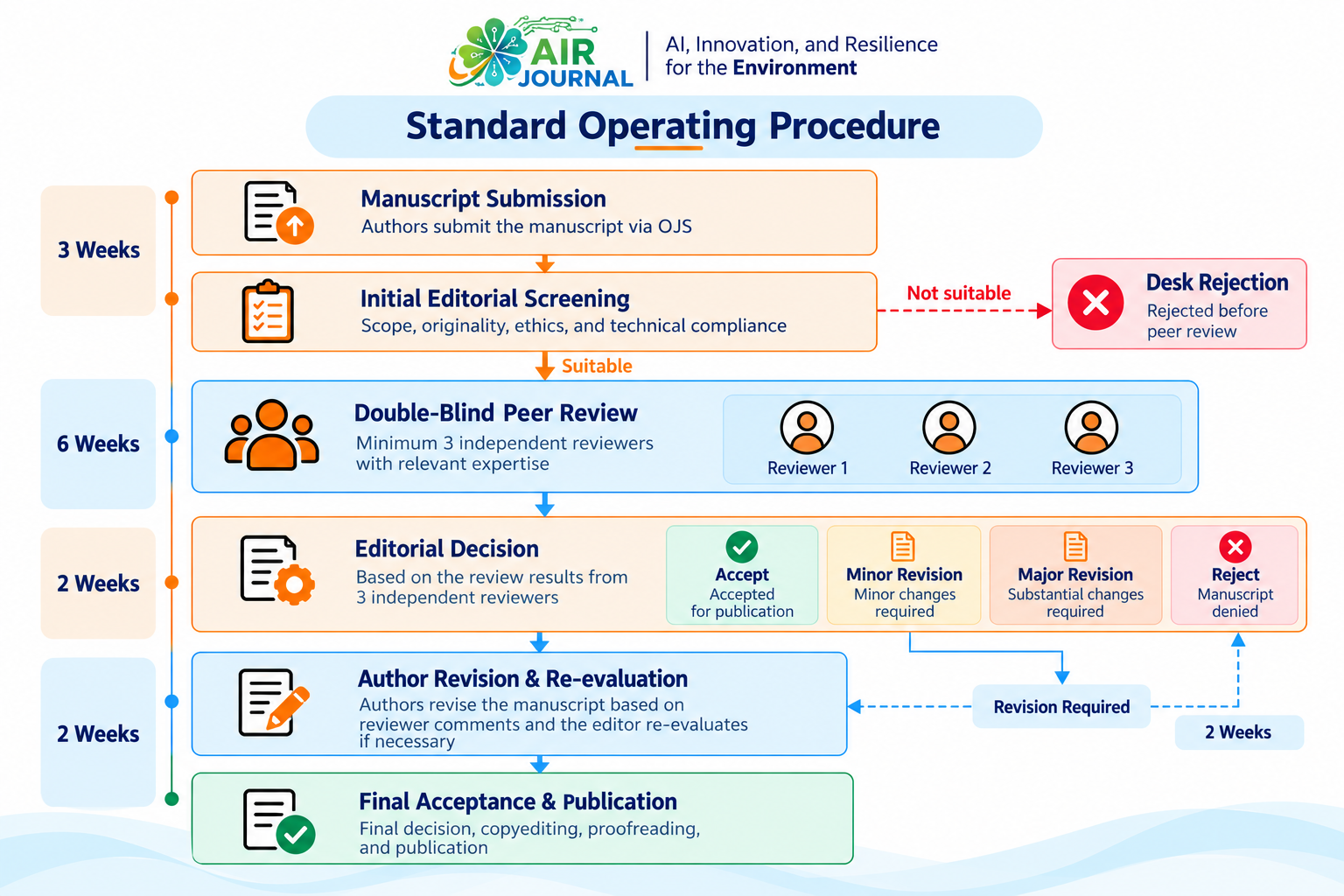
Step 1. Manuscript Submission
Authors submit their manuscripts through the official Online Journal Systems (OJS) platform.
Submitted manuscripts must comply with the journal's focus and scope, author guidelines, research ethics requirements, and submission preparation checklist.
Step 2. Initial Editorial Screening
The editorial team evaluates the manuscript's suitability based on:
- Relevance to the journal's aims and scope.
- Originality and scientific contribution.
- Methodological appropriateness.
- Research integrity and ethical compliance.
- Manuscript completeness and technical formatting.
- Potential plagiarism, redundant publication, or research misconduct.
Manuscripts that do not meet the journal's minimum requirements may be rejected without external peer review.
Step 3. Double-Blind Peer Review
Manuscripts passing initial screening are assigned to at least three independent reviewers.
Reviewers evaluate the manuscript's:
- Originality and novelty.
- Scientific and technical significance.
- Methodological rigor.
- Validity and reliability of results.
- Quality of discussion and interpretation.
- Relevance to environmental sustainability and resilience.
- Clarity of presentation and academic writing.
- Quality and relevance of references.
- Research ethics and transparency.
Reviewers submit independent evaluation reports and recommendations to the editorial team.
04. Publication Frequency
AI, Innovation, and Resilience for the Environment Journal (AIR) follows a semiannual publication schedule, publishing two issues annually in March and September. Manuscripts are accepted throughout the year through the journal's official online submission system. Accepted articles are assigned to the appropriate issues in accordance with the journal's editorial and production procedures. AI, Innovation, and Resilience for the Environment Journal (AIR) is committed to maintaining a transparent and consistent publication schedule, with any changes or updates officially communicated through the journal's website.
05. Open Access Policy
AI, Innovation, and Resilience for the Environment Journal (AIR) is an open-access journal. This journal provides immediate open access to its content on the principle that making research freely available to the public supports a greater global exchange of knowledge, particularly in artificial intelligence, technological innovation, environmental sustainability, and ecological resilience. All content is freely available without charge to the user. Users are allowed to read, download, copy, distribute, print, search, or link to the full texts of the articles, or use them for any other lawful purpose, without asking prior permission from the publisher or the author, provided that the terms of the Creative Commons Attribution 4.0 International License (CC BY 4.0) are respected and appropriate attribution is given to the original authors. For more details, please refer to our Open Access
06. Copyright and Licensing Policy
AI, Innovation, and Resilience for the Environment Journal (AIR) adopts an open-access publishing model that respects authors' intellectual property rights while promoting the dissemination, accessibility, and responsible reuse of scholarly research. Under this policy, authors retain copyright ownership of their original works while granting AI, Innovation, and Resilience for the Environment Journal (AIR) the right of first publication. All published articles are distributed under the Creative Commons Attribution 4.0 International License (CC BY 4.0), which permits users to share, copy, redistribute, adapt, and reuse the published content, including for commercial purposes, provided that appropriate credit is given to the original authors, a link to the license is included, and any modifications are clearly indicated. Third-party materials not covered by the applicable Creative Commons license must be properly identified, acknowledged, and reproduced with the necessary permissions from the respective copyright holders. To ensure transparency and compliance with international open-access publishing standards, AI, Innovation, and Resilience for the Environment Journal (AIR) requires that copyright ownership and licensing information be clearly and consistently displayed on both the article landing page and the published PDF.
07. Author Fees
AI, Innovation, and Resilience for the Environment Journal (AIR) applies an Article Processing Charge (APC) to cover part of the costs associated with editorial administration, peer-review coordination, copyediting, digital publication, DOI registration, and the dissemination of scholarly articles. The journal is committed to communicating its publication fees transparently so that authors can understand the applicable charges before submitting their manuscripts.
Fee Details
| Publication Fee | USD 100 |
| Charging Basis | Per accepted article |
| Payment Timing | After acceptance and before publication, according to the invoice and instructions issued by the journal. |
| Payment Instructions | Authors should follow the official payment instructions provided by the editorial office. |
Fee Transparency and Editorial Independence
Payment of the Article Processing Charge does not guarantee acceptance or influence the outcome of peer review. All manuscripts are evaluated according to the journal's editorial policies, academic quality requirements, and peer-review procedures. Editorial decisions are made independently of payment considerations.
Important Notice
Authors are advised to review the applicable publication fee and waiver policy before submitting a manuscript. Any questions concerning payment, invoices, or fee administration should be directed to the AI, Innovation, and Resilience for the Environment Journal (AIR) editorial office. Authors should not transfer payment to unofficial accounts or individuals.
08. Publication Ethics
AI, Innovation, and Resilience for the Environment Journal (AIR) is a peer-reviewed, open-access scholarly journal published by Sinar Mentari Sundara. This statement clarifies the ethical responsibilities of all parties involved in the publication process, including authors, the Editor-in-Chief, Editorial Board members, peer reviewers, and the publisher.
This statement is based on the principles of the Committee on Publication Ethics (COPE) Core Practices and internationally recognized standards of ethical scholarly publishing. AI, Innovation, and Resilience for the Environment Journal (AIR) is committed to ensuring transparency, fairness, accountability, and research integrity throughout the editorial and publication process. For more details, please refer to our Publication Ethics.
OWNERSHIP
AI, Innovation, and Resilience for the Environment Journal (AIR) | Editorial Policies
↑ Back to Top