Table of Contents
1. Focus and Scope
Smart Human-centered Emerging Research in Machine Intelligence (SHEM Journal) is dedicated to advancing cutting-edge research and innovation in the field of Artificial Intelligence (AI). The journal provides an international platform for the publication of high-quality, original research that contributes to theoretical advancements, methodological developments, and practical applications of AI. SHEM Journal welcomes interdisciplinary studies that promote intelligent technologies capable of addressing complex scientific, industrial, and societal challenges while supporting sustainable and responsible innovation.
1.1 Machine Learning and Intelligent Systems
The journal encourages research on machine learning algorithms, predictive analytics, intelligent decision-support systems, and data-driven computational models. Contributions may include theoretical developments, algorithmic innovations, and practical implementations that enable adaptive, autonomous, and intelligent systems across diverse application domains.
1.2 Deep Learning and Advanced Computational Models
SHEM Journal welcomes studies focusing on deep neural networks, computer vision, pattern recognition, generative artificial intelligence, and advanced computational techniques. Research in this area should demonstrate innovative approaches that address complex real-world problems through intelligent automation, analysis, and predictive capabilities.
1.3 Natural Language Processing and Human-AI Interaction
This area includes research on natural language understanding, conversational artificial intelligence, sentiment analysis, multilingual systems, information retrieval, text mining, and human-centered AI technologies. The journal particularly encourages research that enhances effective interaction and collaboration between humans and intelligent systems.
1.4 Robotics, Automation, and Smart Technologies
Research covering autonomous systems, robotics, intelligent control, Internet of Things (IoT), cyber-physical systems, and smart technologies is within the journal's scope. Manuscripts may present innovative solutions that improve efficiency, productivity, safety, and decision-making in industrial, educational, healthcare, environmental, and public service sectors.
1.5 Artificial Intelligence Ethics and Responsible Innovation
The journal supports research investigating the ethical, legal, social, and governance dimensions of Artificial Intelligence. Topics may include fairness, transparency, accountability, explainability, privacy, trustworthy AI, regulatory frameworks, and responsible innovation that promotes the sustainable and ethical deployment of intelligent technologies.
1.6 Interdisciplinary Artificial Intelligence Applications
SHEM Journal encourages interdisciplinary collaborations that demonstrate the application of Artificial Intelligence across diverse fields, including education, healthcare, business, environmental sustainability, agriculture, transportation, public administration, finance, and other domains where intelligent technologies create significant scientific, economic, and societal impact.
Journal Mission
SHEM Journal aims to become a leading international platform for scholarly communication by disseminating high-quality research that advances both the theory and practical implementation of Artificial Intelligence. Through the promotion of innovative, ethical, and responsible AI research, the journal supports the achievement of the United Nations Sustainable Development Goals (SDGs) while contributing to sustainable technological development and addressing global challenges through intelligent solutions.
2. Section Policies
The following table summarizes the publication policy applied to the Articles section of Smart Human-centered Emerging Research in Machine Intelligence (SHEM Journal). All manuscripts submitted to this section are openly accepted for submission, indexed upon publication, and subjected to a rigorous double-blind peer-review process to ensure academic quality and research integrity.
3. Peer Review Process
Smart Human-centered Emerging Research in Machine Intelligence (SHEM Journal) accepts manuscripts that comply with the journal's author guidelines, formatting requirements, and submission policies. Before entering the peer review stage, each submission undergoes an initial editorial assessment to determine its suitability with the journal's focus and scope, writing quality, ethical standards, and technical requirements. Manuscripts that successfully pass this preliminary evaluation proceed to the formal Double-Blind Peer Review process.
Review Workflow
| 1. | The editorial team performs an initial screening to verify that the manuscript complies with the journal's focus, scope, formatting requirements, and publication ethics. |
| 2. | Eligible manuscripts are assigned to at least two independent anonymous reviewers under the Double-Blind Peer Review model, ensuring that neither authors nor reviewers know each other's identities. |
| 3. | Reviewers assess each manuscript based on its originality, scientific significance, methodological quality, technical accuracy, relevance to the journal, and clarity of presentation. |
| 4. | Reviewer comments and recommendations are communicated to the corresponding author for revision and response whenever necessary. |
| 5. | Following the revision process, the editorial team evaluates the revised manuscript and makes the final publication decision based on the reviewers' recommendations. |
Editorial Decisions
4. Publication Frequency
Smart Human-centered Emerging Research in Machine Intelligence (SHEM Journal) is published on a biannual basis, with two issues released each year in April and October. Manuscripts may be submitted throughout the year and will be considered for publication in the next available issue following the completion of the editorial and peer-review process.
Publication Schedule
Submission Timeline
5. Open Access Statement
Smart Human-centered Emerging Research in Machine Intelligence (SHEM Journal) is a fully Open Access journal. All published articles are freely and permanently accessible online immediately upon publication, allowing researchers, educators, practitioners, and the general public to read, download, copy, distribute, print, search, and link to the full text without financial, legal, or technical barriers.
SHEM Journal supports the principles of open scholarly communication by complying with the Initiative for Open Citations (I4OC) standards. All published articles are distributed under the Creative Commons Attribution 4.0 International (CC BY 4.0) License, which promotes the widest possible dissemination and reuse of scientific knowledge while ensuring proper attribution to the original authors.
You Are Free To
| ✓ | Share — Copy and redistribute the material in any medium or format. |
| ✓ | Adapt — Remix, transform, and build upon the material for any purpose, including commercial use. |
Under the Following Terms
| 1. | Attribution — Appropriate credit must be given to the original author(s), a link to the license must be provided, and any modifications should be clearly indicated. Attribution must not imply endorsement by the licensor. |
| 2. | No Additional Restrictions — Users may not apply legal or technological measures that restrict others from exercising the rights granted by the license. |
Important Notices
The license does not apply to material that is already in the public domain or where an applicable legal exception or limitation permits its use.
No warranties are provided under this license. Certain rights, including privacy, publicity, or moral rights, may still affect how the material can be used depending on the applicable jurisdiction.
6. Archiving
Smart Human-centered Emerging Research in Machine Intelligence (SHEM Journal) utilizes the LOCKSS (Lots of Copies Keep Stuff Safe) and CLOCKSS systems to establish a distributed archiving network among participating libraries. These preservation systems ensure the long-term availability, integrity, and accessibility of published scholarly content by allowing participating institutions to create permanent archives for preservation and restoration purposes.
Digital Preservation
The implementation of LOCKSS and CLOCKSS supports the journal's commitment to long-term digital preservation, ensuring that published articles remain accessible even in the event of data loss or service interruption.
Learn More About LOCKSS →7. Publication Ethics
Smart Human-centered Emerging Research in Machine Intelligence (SHEM Journal) is an international peer-reviewed, open-access journal committed to maintaining the highest standards of publication ethics and research integrity. This statement outlines the ethical responsibilities of all parties involved in the publication process, including authors, editors, editorial board members, reviewers, and the publisher (Sinar Mentari Sundara). The journal's ethical policies are developed in accordance with the COPE Core Practices and the principles previously established in the COPE Code of Conduct and Best Practice Guidelines for Journal Editors.
Ethical Guideline for Journal Publication
The publication of scholarly articles in Smart Human-centered Emerging Research in Machine Intelligence (SHEM Journal) plays an essential role in developing a credible and sustainable body of scientific knowledge. Published articles reflect the quality of the authors' research as well as the institutions supporting their work. Through a rigorous peer-review process, the journal promotes scientific integrity, transparency, and academic excellence. Therefore, all participants in the publication process—including authors, editors, reviewers, publishers, and the wider academic community—are expected to uphold the highest ethical standards.
Generative AI Policies
As the use of Artificial Intelligence continues to evolve in scholarly publishing, SHEM Journal has established clear standards governing the responsible, transparent, and ethical use of Generative Artificial Intelligence (GenAI). Authors, reviewers, and editors are required to comply with the journal's Generative AI Policy in addition to the publication ethics and research integrity principles described on this page.
Read Generative AI Policies →Publisher and Editor
Sinar Mentari Sundara, as the publisher of Smart Human-centered Emerging Research in Machine Intelligence (SHEM Journal), takes responsibility for safeguarding every stage of the publication process. The publisher is committed to ensuring that editorial decisions remain completely independent from commercial interests, including advertising, sponsorship, or reprint revenue. Where appropriate, the Editorial Board will cooperate with other journals and publishers to maintain publication ethics and resolve matters relating to research integrity.
Editorial Responsibilities
Publication Decisions
The Editor-in-Chief is responsible for determining which submitted manuscripts are accepted for publication. Editorial decisions are based on the manuscript's scientific merit, originality, relevance to the journal's scope, and contribution to the research community. Editors also consider applicable legal requirements regarding copyright, libel, plagiarism, and research misconduct, and may consult reviewers or members of the Editorial Board before making a final decision.
Fair Play
Editors evaluate submitted manuscripts exclusively on the basis of their academic quality, originality, and relevance to the journal. Editorial decisions are made without discrimination based on race, gender, sexual orientation, religious belief, ethnic origin, citizenship, or political philosophy of the authors.
Confidentiality
Editors and editorial staff must maintain the confidentiality of all submitted manuscripts. Information relating to a manuscript may only be disclosed to the corresponding author, assigned reviewers, potential reviewers, editorial advisers, or the publisher when necessary for the editorial process.
Disclosure and Conflicts of Interest
Editors must not use unpublished information disclosed in a submitted manuscript for their own research without the author's explicit written permission. Any actual or potential conflicts of interest must be managed appropriately to preserve the integrity and impartiality of the editorial process.
Complaints Policy
Smart Human-centered Emerging Research in Machine Intelligence (SHEM Journal) is committed to responding to and resolving all complaints in a fair, transparent, and timely manner. Every complaint will be handled objectively, ensuring fairness both to the complainant and to the individual or party concerned. Complaints should be submitted via email and will be acknowledged within five (5) working days. The Editorial Office will investigate each complaint carefully and communicate the outcome as appropriate.
Duties of Reviewers
Contribution to Editorial Decisions
Peer review assists editors in making informed editorial decisions and provides constructive feedback that helps authors improve the quality, clarity, and scientific contribution of their manuscripts.
Promptness
Reviewers who consider themselves unqualified to review a manuscript, or who are unable to complete the review within the required timeframe, should promptly inform the editor and decline the review invitation.
Confidentiality
All manuscripts received for review must be treated as confidential documents. They must not be shared, discussed, or disclosed to anyone except with the explicit authorization of the editor.
Standards of Objectivity
Reviews should be conducted objectively, fairly, and professionally. Personal criticism of the author is inappropriate. Reviewers should provide clear, evidence-based comments supported by constructive arguments.
Acknowledgement of Sources
Reviewers should identify relevant published work that has not been cited by the authors. They should also inform the editor of any substantial similarity or overlap between the manuscript under review and other published works of which they are aware.
Disclosure and Conflicts of Interest
Information or ideas obtained through peer review must remain confidential and must not be used for personal advantage. Reviewers should decline to evaluate manuscripts in which they have financial, professional, institutional, or personal conflicts of interest.
Duties of Authors
Reporting Standards
Authors should present an accurate, honest, and objective account of their research. Manuscripts must contain sufficient detail, appropriate references, and reliable data to allow others to replicate the study. Fabrication, falsification, or knowingly inaccurate statements constitute unethical publishing behavior.
Data Access and Retention
Authors may be requested to provide the raw data supporting their research for editorial review and should retain such data for a reasonable period following publication in accordance with accepted scholarly standards.
Originality and Plagiarism
Authors must ensure that submitted manuscripts are entirely original. Any work, data, or words taken from other sources must be appropriately cited or quoted in accordance with accepted academic practices.
Multiple, Redundant, or Concurrent Publication
Authors should not submit the same manuscript to more than one journal simultaneously or publish substantially similar research in multiple journals without proper justification.
Acknowledgement of Sources
Appropriate acknowledgment of the work of others must always be provided. Authors are responsible for citing publications that have significantly influenced their research.
Authorship of the Paper
Authorship should be limited to individuals who have made substantial contributions to the conception, design, execution, or interpretation of the study. The corresponding author is responsible for ensuring that all eligible co-authors are appropriately listed and that all authors have reviewed and approved the final manuscript prior to submission.
Disclosure and Conflicts of Interest
Authors must disclose any financial, institutional, or personal conflicts of interest that could influence the interpretation of their findings. All sources of financial support should be clearly acknowledged within the manuscript.
Fundamental Errors in Published Works
If an author discovers a significant error or inaccuracy in a published article, the author has an obligation to promptly notify the journal editor or publisher and cooperate fully in correcting or retracting the publication where necessary.
8. Editorial and Editing Process
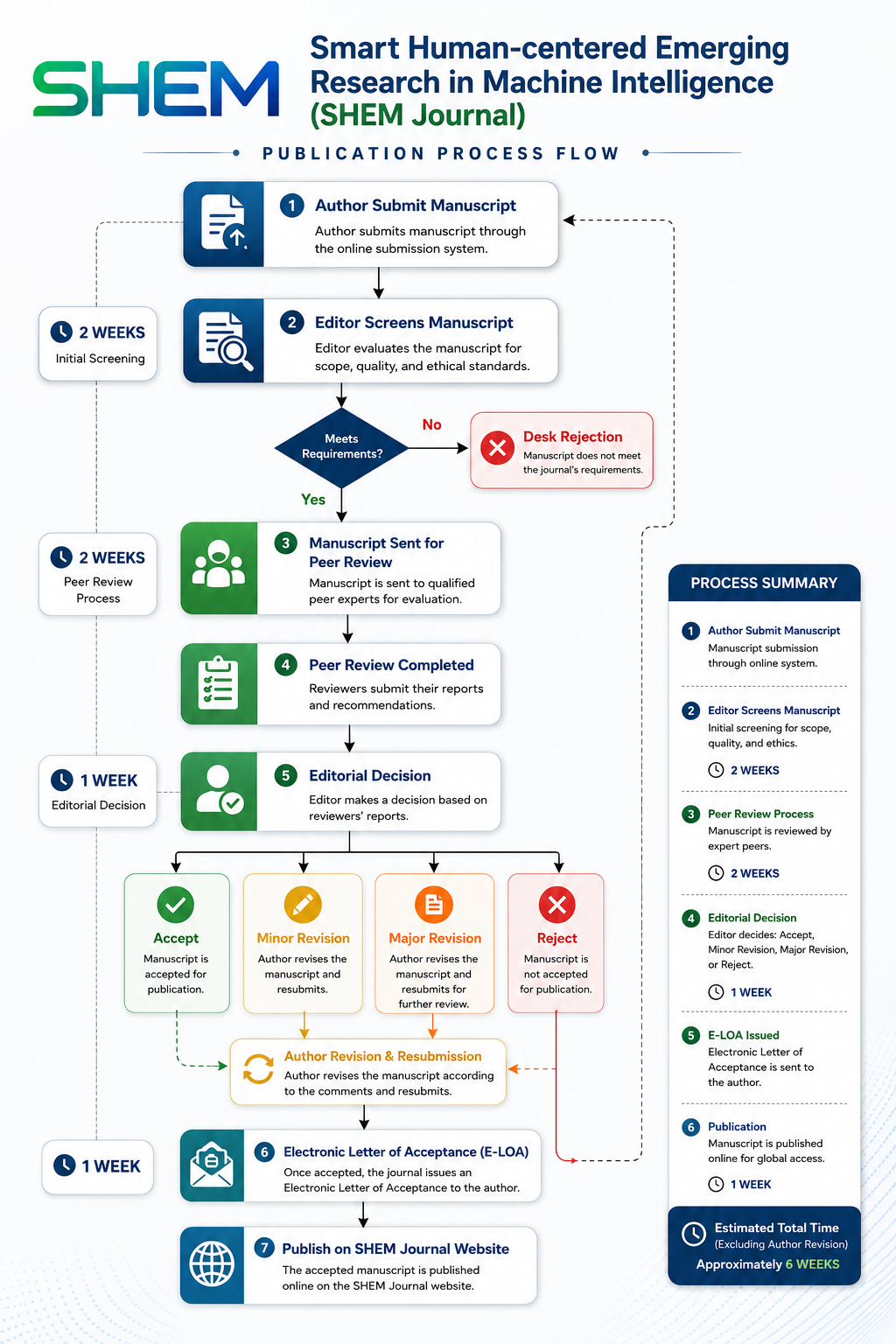
The editorial and editing workflow of Smart Human-centered Emerging Research in Machine Intelligence (SHEM Journal) illustrates the complete publication process, beginning with manuscript submission, editorial screening, peer review, revision, copyediting, production, and final publication. This workflow ensures a transparent, rigorous, and efficient editorial process while maintaining the highest standards of scholarly publishing.
9. Indexing
Smart Human-centered Emerging Research in Machine Intelligence (SHEM Journal) is committed to maximizing the visibility, accessibility, and long-term impact of published research through registration with internationally recognized indexing services and scholarly databases.
Digital Object Identifier (DOI)
Every article published in SHEM Journal is assigned a persistent Digital Object Identifier (DOI) through Crossref, ensuring reliable citation, permanent accessibility, and long-term discoverability within the global scholarly communication ecosystem.
DOI Prefix: https://doi.org/10.33050/shem
Indexed In
SHEM Journal is indexed, abstracted, or registered in the following academic databases and scholarly discovery services.







10. Screening for Plagiarism
All manuscripts submitted to Smart Human-centered Emerging Research in Machine Intelligence (SHEM Journal) undergo plagiarism screening prior to the peer-review process to ensure the originality and integrity of the published research.
Similarity Checking
Submitted manuscripts are screened using Turnitin. As a general policy, manuscripts with an overall similarity index exceeding 30% may be returned to the authors for revision, rejected, or subjected to further editorial evaluation depending on the nature, source, and context of the identified similarities.
Plagiarism Detection Software
The journal utilizes Turnitin as its official plagiarism detection software to support editorial assessment and uphold international standards of publication ethics and academic integrity.
11. Self-Archiving of Papers Published Open Access
Smart Human-centered Emerging Research in Machine Intelligence (SHEM Journal) encourages authors to maximize the visibility and long-term accessibility of their published research through responsible self-archiving practices.
Self-Archiving Policy
Authors publishing in SHEM Journal are encouraged to deposit the final published PDF version of their article in their institutional repository or another appropriate subject repository immediately after publication. This practice supports wider dissemination, increased visibility, and long-term preservation of scholarly work.
Repository Requirements
| 1. | The deposited version should be the final published PDF available from the journal. |
| 2. | Authors should include a direct link from the deposited version to the official published article on the SHEM Journal website. |
| 3. | The version hosted on the journal's website remains the Version of Record and should always be recognized as the definitive and authoritative published version. |
| 4. | Providing a link to the journal website helps preserve the integrity, authenticity, citation accuracy, and long-term scholarly record of the published article. |