
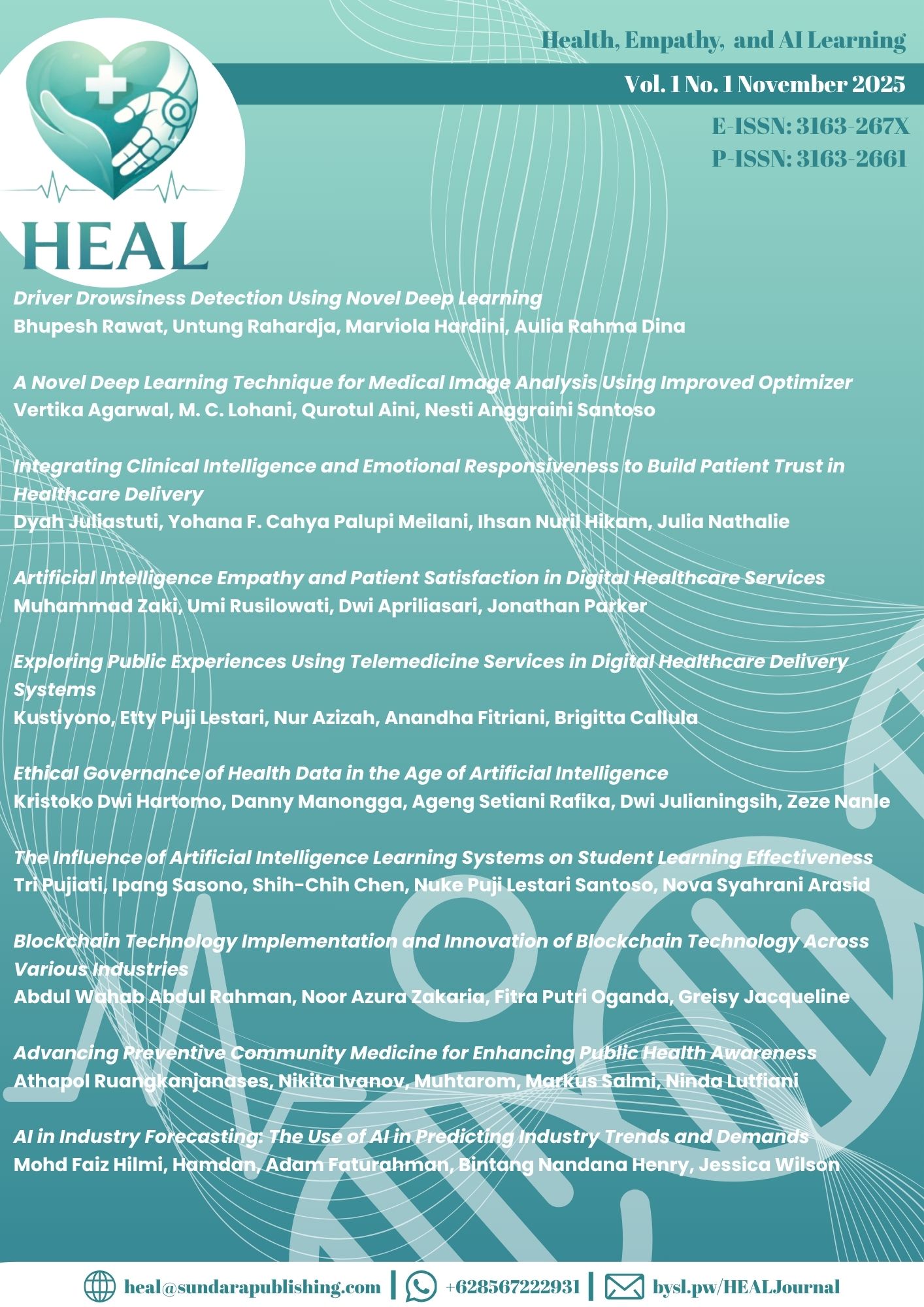
Artificial Intelligence Empathy and Patient Satisfaction in Digital Healthcare Services
DOI:
https://doi.org/10.68012/heal.v1i1.98Keywords:
Artificial Intelligence, Machine Empathy, Patient Trust, Patient Satisfaction, Digital Health ServicesAbstract
Artificial intelligence has rapidly transformed healthcare systems by improving efficiency, diagnostic accuracy, and accessibility of medical services. Digital healthcare platforms increasingly integrate artificial intelligence technologies to support telemedicine, health monitoring, and medical consultations. These innovations enable patients to access healthcare services more conveniently and help healthcare providers deliver faster and more efficient care. Namun, the increasing reliance on artificial intelligence in healthcare also raises concerns regarding the lack of emotional interaction and empathetic communication between patients and digital systems. The absence of empathetic responses in AI-based healthcare services may influence patient trust and satisfaction when interacting with digital health technologies. Therefore, understanding the role of machine empathy in artificial intelligence systems becomes important in developing human-centered healthcare services. This study aims to examine the influence of artificial intelligence service quality and machine empathy on patient trust and patient satisfaction in digital healthcare platforms. The research employed a quantitative approach using a survey method involving 150 respondents who had experience using telemedicine applications. Data were collected using an online questionnaire with a five-point Likert scale and analyzed using Structural Equation Modeling. The findings indicate that artificial intelligence service quality and machine empathy significantly influence patient trust and patient satisfaction. Furthermore, patient trust demonstrates a strong positive relationship with patient satisfaction. These results highlight the importance of integrating empathetic capabilities into artificial intelligence systems to improve patient experience in digital healthcare environments.
Downloads
References
[1] E. Morrow, T. Zidaru, F. Ross, C. Mason, K. D. Patel, M. Ream, and R. Stockley, “Artificial intelligence technologies and compassion in healthcare: A systematic scoping review,” Frontiers in psychology, vol. 13, p. 971044, 2023.
[2] X. Wang, R. Wang, F. Sheng, and L. Chen, “The effects of empathy by caregivers on healthcare service satisfaction,” Frontiers in Psychology, vol. 13, p. 912076, 2022.
[3] A. S. Eldaly, M. J. Maniaci, M. R. Paulson, F. R. Avila, R. A. Torres-Guzman, K. Maita, J. P. Garcia, and A. J. Forte, “Patient satisfaction with telemedicine in acute care setting: a systematic review,” Journal of Clinical and Translational Research, vol. 8, no. 6, p. 540, 2022.
[4] K. Perez, D. Wisniewski, A. Ari, K. Lee, C. Lieneck, and Z. Ramamonjiarivelo, “Investigation into application of ai and telemedicine in rural communities: a systematic literature review,” in Healthcare, vol. 13, no. 3. MDPI, 2025, p. 324.
[5] P. K. Edhi and A. Heryjanto, “Influence e-service quality to customer satisfaction mediated by e-trust (empirical study: Telemedicine users at x hospital tangerang),” International Journal of Research and Review, vol. 3, no. 1, 2023.
[6] U. Rahardja, Q. Aini, A. S. Bist, S. Maulana, and S. Millah, “Examining the interplay of technology readiness and behavioural intentions in health detection safe entry station,” JDM (Jurnal Dinamika Manajemen), vol. 15, no. 1, pp. 125–143, 2024.
[7] H. R. Adinda, R. A. Syakurah, and P. Pariyana, “User satisfaction and challenges in telemedicine services during the covid-19 pandemic in indonesia: A population-based analysis,” Journal of Health Policy and Management, vol. 9, no. 2, pp. 237–249, 2024.
[8] A. Sari, “Effectiveness of ai-based telemedicine in improving treatment compliance of chronic disease patients in the post-pandemic era: A multicenter study in indonesia,” Jurnal Health Sains, vol. 6, no. 3, pp. 181–190, 2025.
[9] A. Sharma, I. W. Lin, A. S. Miner, D. C. Atkins, and T. Althoff, “Human–ai collaboration enables more empathic conversations in text-based peer-to-peer mental health support,” Nature Machine Intelligence, vol. 5, no. 1, pp. 46–57, 2023.
[10] A. Howcroft, A. Bennett-Weston, A. Khan, J. Griffiths, S. Gay, and J. Howick, “Ai chatbots versus human healthcare professionals: a systematic review and meta-analysis of empathy in patient care,” British Medical Bulletin, vol. 156, no. 1, p. ldaf017, 2025.
[11] M. Luo, B. Harandizadeh, A. Tariq, H. Abbas, U. Ghaffar, C. J. Warren, S. O. Kolade, and H. M. Abdul- Muhsin, “From generation to collaboration: Using llms to edit for empathy in healthcare,” arXiv preprint arXiv:2601.15558, 2026.
[12] K. Haut, C. Wohn, B. Kane, T. Carroll, C. Guigno, V. Kumar, R. Epstein, L. Schuber, and E. Hoque, “Validating a virtual human and automated feedback system for training doctor-patient communication skills,” in 2023 11th International Conference on Affective Computing and Intelligent Interaction (ACII). IEEE, 2023, pp. 1–8.
[13] C. S. Kruse, N. Krowski, B. Rodriguez, L. Tran, J. Vela, and M. Brooks, “Telehealth and patient satisfaction: a systematic review and narrative analysis,” BMJ open, vol. 7, no. 8, p. e016242, 2017.
[14] M. A. Alabdali and K. S. Husain, “Understanding the relationship between patient satisfaction and loyalty through telemedicine platform quality: an empirical study,” International Journal of Healthcare Management, vol. 18, no. 2, pp. 253–265, 2025.
[15] E. J. Topol, “High-performance medicine: the convergence of human and artificial intelligence,” Nature medicine, vol. 25, no. 1, pp. 44–56, 2019.
[16] P. Rajpurkar, E. Chen, O. Banerjee, and E. J. Topol, “Ai in health and medicine,” Nature medicine, vol. 28, no. 1, pp. 31–38, 2022.
[17] N. N. Majumder and B. O. Adebiyi, “Human-centered ai in healthcare,” in Handbook of Human-Centered Artificial Intelligence. Springer, 2026, pp. 1–55.
[18] A. Pambudi, N. Lutfiani, M. Hardini, A. R. A. Zahra, and U. Rahardja, “The digital revolution of startup matchmaking: Ai and computer science synergies,” in 2023 Eighth International Conference on Informatics and Computing (ICIC). IEEE, 2023, pp. 1–6.
[19] F. Jiang, Y. Jiang, H. Zhi, Y. Dong, H. Li, S. Ma, Y. Wang, Q. Dong, H. Shen, and Y. Wang, “Artificial intelligence in healthcare: past, present and future,” Stroke and vascular neurology, vol. 2, no. 4, 2017.
[20] S. Reddy, S. Allan, S. Coghlan, and P. Cooper, “A governance model for the application of ai in health care,” Journal of the American medical informatics association, vol. 27, no. 3, pp. 491–497, 2020.
[21] E. A. Abou Hashish, “Compassion through technology: Digital empathy concept analysis and implications in nursing,” Digital health, vol. 11, p. 20552076251326221, 2025.
[22] E. Topol, Deep medicine: how artificial intelligence can make healthcare human again. Hachette UK, 2019.
[23] B. Stukes, J. K. Olive, and B. B. Scully, “Empathy in the era of artificial intelligence: Coexistence or competition?” The Journal of Thoracic and Cardiovascular Surgery, vol. 170, no. 5, pp. e130–e131, 2025.
[24] E. Fisher, M. A. Flynn, P. Pratap, and J. A. Vietas, “Occupational safety and health equity impacts of artificial intelligence: a scoping review,” International journal of environmental research and public health, vol. 20, no. 13, p. 6221, 2023.
[25] X. Yang, D. Mu, H. Peng, H. Li, Y. Wang, P. Wang, Y. Wang, and S. Han, “Research and application of artificial intelligence based on electronic health records of patients with cancer: systematic review,” JMIR Medical Informatics, vol. 10, no. 4, p. e33799, 2022.
[26] M. Jabbar, H. Iqbal, and U. Chawla, “Patient satisfaction: The role of artificial intelligence in healthcare,” Journal of Health Management, p. 09720634241246331, 2024.
[27] T. Davenport and R. Kalakota, “The potential for artificial intelligence in healthcare,” Future healthcare journal, vol. 6, no. 2, pp. 94–98, 2019.
[28] S. Keesara, A. Jonas, and K. Schulman, “Covid-19 and health care’s digital revolution,” New England Journal of Medicine, vol. 382, no. 23, p. e82, 2020.
[29] T. Bickmore and T. O’Leary, “Conversational agents on smartphones and the web,” in Digital therapeutics or mental health and addiction. Elsevier, 2023, pp. 99–112.
[30] M. Javaid, A. Haleem, R. P. Singh, and R. Suman, “Artificial intelligence applications for industry 4.0: A literature-based study,” Journal of Industrial Integration and Management, vol. 7, no. 01, pp. 83–111, 2022.
[31] M. Chen and M. Decary, “Artificial intelligence in healthcare: An essential guide for health leaders,” in Healthcare management forum, vol. 33, no. 1. Sage Publications Sage CA: Los Angeles, CA, 2020, pp. 10–18.
[32] A. Choudhury and H. Shamszare, “Human factors influencing trust in healthcare artificial intelligence: Systematic literature review,” IISE Transactions on Occupational Ergonomics and Human Factors, pp. 1–16, 2026.
[33] F. Syafariani, M. S. Lola, S. S. S. Abd Mutalib, W. N. F. W. Nasir, A. A. K. A. Hamid, and N. H. Zainuddin, “Leveraging a hybrid machine learning model for enhanced cyberbullying detection,” Aptisi Transactions on Technopreneurship (ATT), vol. 7, no. 2, pp. 371–386, 2025.
Downloads
Published
Issue
Section
License
Copyright (c) 2025 Muhammad Zaki, Umi Rusilowati, Dwi Apriliasari, Jonathan Parker

This work is licensed under a Creative Commons Attribution 4.0 International License.


