
 Open Submissions

Editorial Policies
Editorial Policies
- Focus and Scope
- Section Policies
- Peer Review Process
- Publication Frequency
- Open Access
- Article Publishing Charge (APC)
- Waiver Policy
- Self-Archiving of Papers Published Open Access
Focus and Scope
Health, Empathy, and AI Learning (HEAL) aspires to become a leading intellectual hub for research that integrates technological innovation with humane healthcare practices while supporting the United Nations Sustainable Development Goals (SDGs), particularly in the domains of health equity, sustainable healthcare systems, and digital inclusion. The journal prioritizes the development of Empathetic Artificial Intelligence and promotes the concept of Orange Technology, which focuses on technologies that foster emotional wellbeing, cultural sensitivity, and social resilience. Its scope encompasses interdisciplinary research including empathetic AI in medical diagnostics, robotic nursing and patient-centered care, AI-driven mental health support systems, preventive community medicine through smart monitoring technologies, and ethical governance of health data. Through these focus areas, HEAL seeks to encourage innovations that not only process complex medical data but also enhance compassionate interactions, equitable healthcare access, and sustainable medical practices across diverse global communities.
Our Focus and Scope
HEAL aims to be a dynamic intellectual and research hub, particularly in the field of Empathetic Artificial Intelligence and promotes the concept of Orange Technology. Our focus areas, aligned with the United Nations Sustainable Development Goals (SDGs), include:
1. Empathetic AI in Diagnostics: Developing algorithms that integrate patient history with emotional context for holistic health monitoring.
2. Robotic Nursing and Patient Care: Innovations in autonomous systems that assist in physical rehabilitation, elderly care, and bedside support while maintaining human dignity.
3. Orange Technology for Mental Health: Utilizing creative and emotionally intelligent AI to combat loneliness, provide therapy, and foster community resilience.
4. Preventive Community Medicine: Smart tools for early detection and sustainable health management in rural and post-pandemic urban environments.
5. Ethical Health Data Governance: Frameworks for protecting patient privacy and ensuring transparency in autonomous medical decision-making.
Our focus and scope ensures that our research supports global efforts toward sustainable economic and social development. These diverse entrepreneurial approaches synergize to foster innovation, drive economic growth, and address social challenges. Our focus is on all entrepreneurial activities empowered by technology, encouraging advancements that contribute to sustainable development.
Peer Review Process
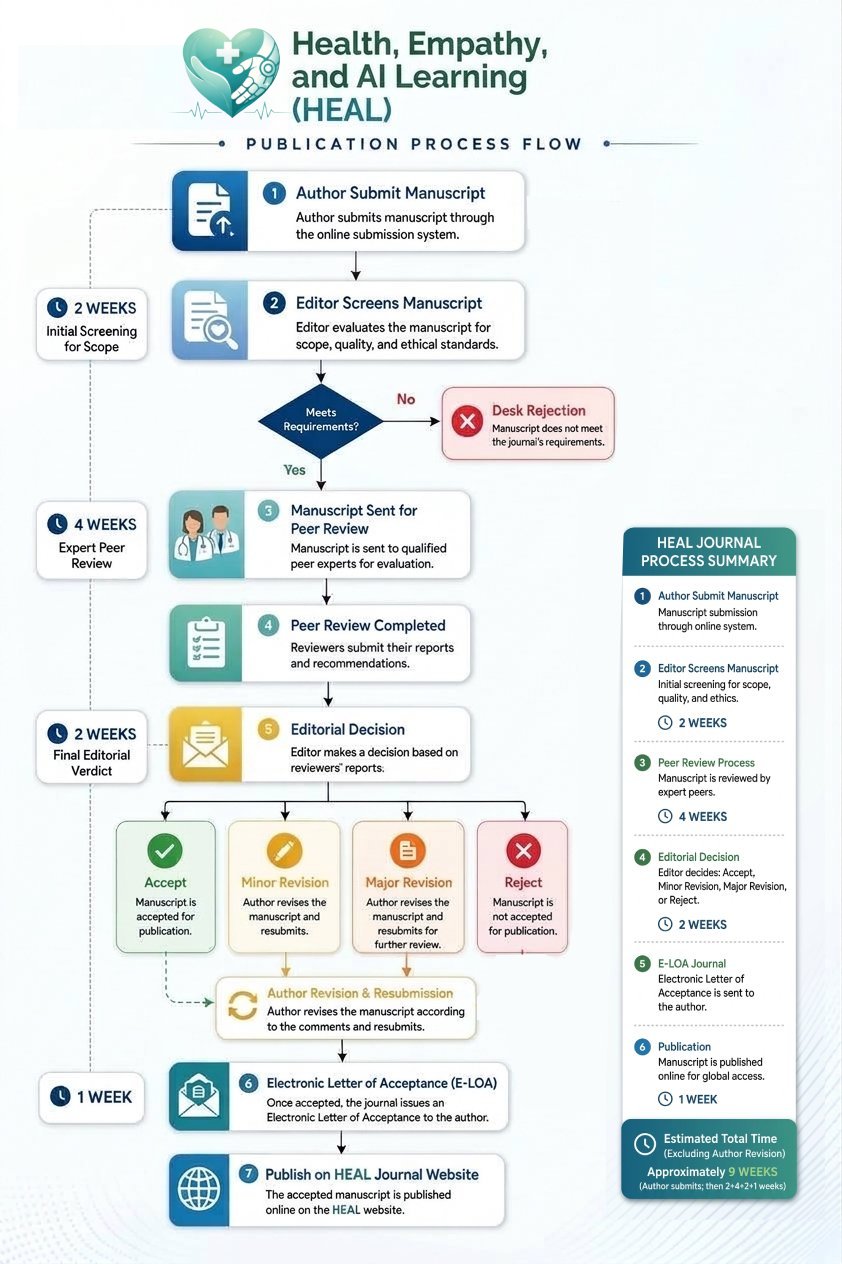
Health, Empathy, and AI Learning applies a rigorous double-blind peer review process where the identities of both authors and reviewers are kept strictly confidential to maintain the quality and integrity of published articles. The entire review and evaluation workflow is designed to be completed within an estimated timeframe of 9 weeks.
All submitted manuscripts are processed through the Open Journal Systems (OJS) and undergo the following stages:
1. Initial Screening
The editorial team checks the manuscript for its suitability with the journal's focus and scope, author guidelines, template, and basic publication requirements.
2. Reviewer Assignment
Manuscripts that pass the initial screening are assigned to at least 3 (three) independent anonymous reviewers with relevant expertise.
3. Double-Blind Peer Review
The identities of both authors and reviewers are kept confidential throughout the review process.
4. Manuscript Evaluation
Reviewers evaluate the manuscript based on originality, scientific contribution, methodology, relevance, clarity of presentation, and overall academic quality.
5. Revision Process
Reviewer comments are sent to the corresponding author. Authors are required to revise the manuscript and respond to the reviewers' comments when revisions are requested.
6. Editorial Decision
Based on the reviewer recommendations and manuscript evaluation, the Editor makes one of the following decisions:
- Accepted
- Minor Revision
- Major Revision
- Rejected
7. Copyediting and Production
Accepted manuscripts proceed to the copyediting and production stages before final publication.
8. Acceptance & Final Publication
Action: Once fully Accepted (or after successfully completing revisions), an electronic Letter of Acceptance (e-LOA) is issued to the author, and the final version is uploaded to the official HEAL archive/website.
The final decision on the manuscript remains the responsibility of the Editor, taking into consideration the reviewers' recommendations and the journal's editorial policies.
Publication Frequency
HEAL publishes biannual, scheduled for May and November. Manuscripts may be submitted at any time throughout the year, and accepted papers will be included in the nearest upcoming issue according to the editorial workflow.
Each issue of HEAL publishes approximately 10 peer-reviewed articles, amounting to about 20 articles annually. The editorial process (https://journal.sundarapublishing.com/index.php/heal/editorialpolicies/#EditorialandEditingProcess) follows the Standard Operating Procedure (SOP), which ensures rigorous peer review and transparent editorial management.
Following submission, manuscripts are screened by the editors within 2 weeks. Eligible manuscripts proceed to peer review by subject experts, typically completed within another 4 weeks. Peer review reports are evaluated by the editorial team, and an editorial decision is usually communicated within 2 weeks. In cases where revisions are required, authors are provided to resubmit. Final accepted papers are uploaded and published online according to the scheduled issues (May and November).
This structured process ensures timely, transparent, and fair editorial management, fully aligned with the journal’s commitment to academic integrity and quality.
Open Access
Health, Empathy, and AI Learning (HEAL) is an open-access journal. This journal provides immediate open access to its content on the principle that making research freely available to the public supports a greater global exchange of knowledge. All content is freely available without charge to the user. Users are allowed to read, download, copy, distribute, print, search, or link to the full texts of the articles, or use them for any other lawful purpose, without asking prior permission from the publisher or the author.
Health, Empathy, and AI Learning (HEAL) is a fully Open Access journal. In accordance with the principles of the Budapest Open Access Initiative (BOAI), all published articles, reviews, and editorial materials are made freely, permanently, and immediately available online worldwide upon publication without subscription fees, paywalls, or registration barriers.
HEAL also supports and complies with the Initiative for Open Citations (I4OC) standards, ensuring that all article citation metadata and reference lists deposited with Crossref are unrestricted and openly accessible for global scholarly discovery.
You are free to:
- Share — Copy and redistribute the material in any medium or format.
- Adapt — Remix, transform, and build upon the material for any purpose, including commercial use.
Under the following terms:
- Attribution — Proper credit must be given, along with a link to the license, and any modifications must be indicated. Attribution should be made in a reasonable manner that does not imply endorsement by the licensor.
-
No additional restrictions — No legal or technological measures may be applied that restrict others from using the material beyond what the license permits.
Notices:
- The license does not apply to elements in the public domain or where usage is permitted by applicable exceptions or limitations.
- No warranties are provided. The license may not grant all necessary permissions for specific uses. Additional rights, such as those related to publicity, privacy, or moral rights, may apply and should be considered before use.
Article Publishing Charge (APC)
To provide open access, this journal has a publication fee (Article Publishing Charge) which needs to be met by the authors, or their institution or funders, for each article published open access. This ensures your article will be immediately and permanently free to access by everyone.
The Article Publishing Charge for this journal is: USD 100 (Excl. Taxes)
Waiver Policy
Authors are eligible for a full waiver or discount on the APC if they are;
1. The corresponding author of the article, and
2. Based in one of the low and middle income countries and regions listed.
An author’s eligibility will not affect peer review or editorial decision-making. APC waivers and discounts are managed by HEAL staff. Journal editors or peer reviewers are not informed about APC waiver eligibility or receipt.
How to request an APC waiver or discount:
1. Authors must submit a written request (via email or formal letter) at the time of manuscript acceptance.
2. The request should include a brief explanation of financial constraints and, where applicable, information on institutional or funding support.
Self-Archiving of Papers Published Open Access
This journal utilizes the LOCKSS and CLOCKSS system to create a distributed archiving system among participating libraries and permits those libraries to create permanent archives of the journal for purposes of preservation and restoration.
Authors publishing open access are encouraged to deposit the final published PDF in their institutional repository or any suitable subject repository on publication. Authors should provide a link from the deposited version to the URL of the published article on the journal's website; in all cases, the requirement to link to the journal’s website is designed to protect the integrity and authenticity of the scientific record, with the online published version on the journal’s website clearly identified as the definitive version of record.
Ownership
Sinar Mentari Sundara, Indonesia.


